I am not a doctor, and this piece does not pretend otherwise. What I have is thirty years of turning up at Malaysian clinics — my own hypertension since 52, my mother's diabetes, and two years of hospital appointments with my father before he died. In that time I bought a RM2,000 screening package that told me nothing I could act on, and paid a few ringgit at a Klinik Kesihatan for the follow-up that actually kept my blood pressure down.
So the question I have learned to ask is not which package is best. It is what am I trying to catch, and how often. After 50 the answer narrows to a short list, and most of that list is available in the public system for very little money.
What the public system already does well
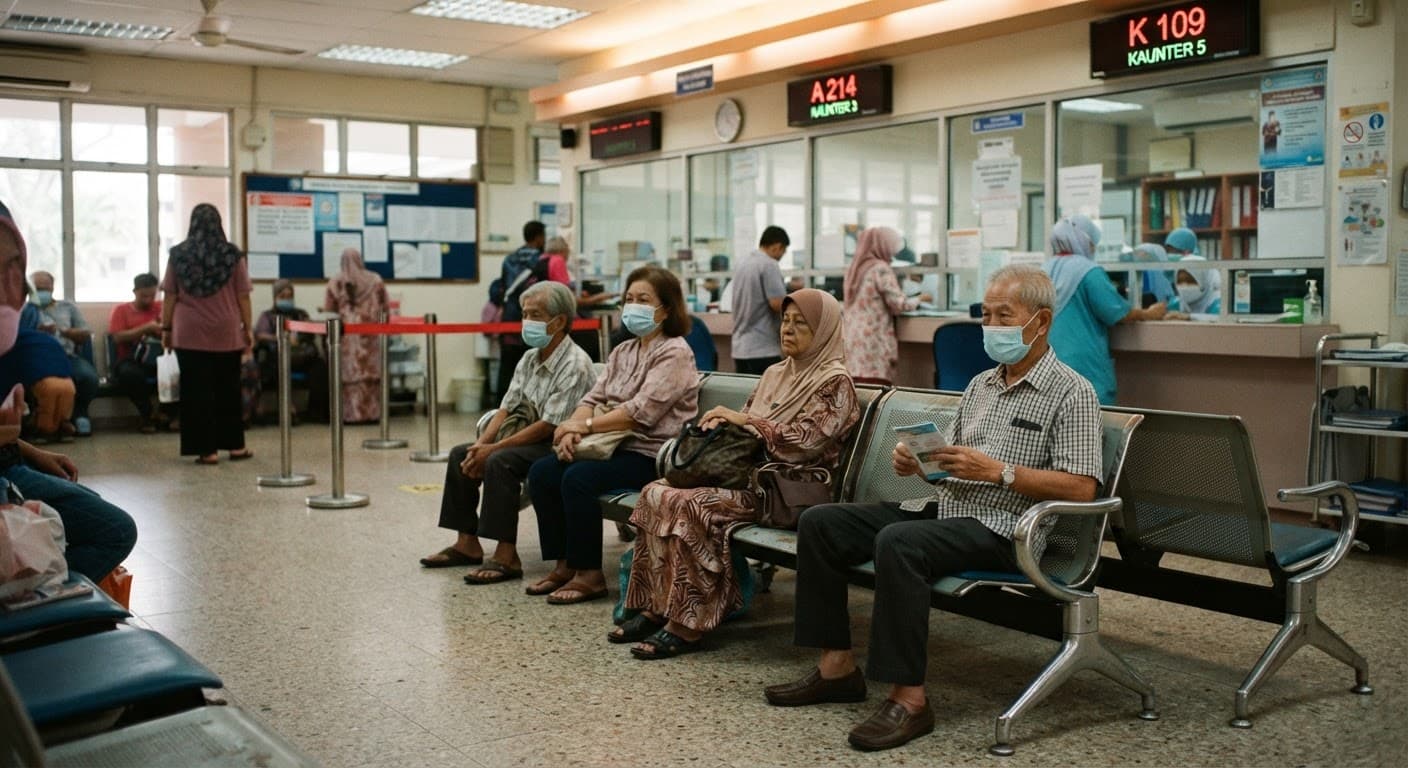
For anyone with hypertension, diabetes or high cholesterol, Klinik Kesihatan follow-up is the best value in Malaysian healthcare, and I say that as someone who spent years assuming private must be better. Blood pressure, fasting glucose, HbA1c and a lipid profile are run on schedule, medication is dispensed on the spot, and the record follows you between clinics. When I was paying privately for the same monitoring, I was not getting a different answer — I was getting a shorter queue and a bigger bill.
Where a private package genuinely adds something
Two tests are worth paying for if the money is there. The first is a colonoscopy when a FIT test is positive or when there is family history — the public queue for diagnostic colonoscopy can run many months, and for something whose entire purpose is to catch a problem early, that wait is the part worth buying out. The second is a low-dose CT for lung assessment if you are a long-term smoker; it exists in the public system but access is limited.
Mammograms sit in between. The public programme offers them, and private screening is fast and well-run. What I have learned is that the test is only useful if you will actually act on the result, so choose the route you will genuinely complete every two years rather than the one that looks better on paper.
What a private screening package actually costs, test by test
The reason my RM2,000 package felt expensive was not the tests I needed. It was everything bundled around them. Priced individually, the shortlist above costs a fraction of the package, and most of it is available in the public system at the prices below. Treat these as a budget rather than a quote — fees move, and a private figure depends on the hospital, the doctor and whether a procedure needs sedation.
| Test | Klinik Kesihatan | Private hospital |
|---|---|---|
| Blood pressure measurement | Free to RM5 | RM20–40 |
| Fasting glucose or HbA1c | RM1–10 | RM40–90 |
| Lipid (cholesterol) profile | RM1–10 | RM50–120 |
| Kidney function (creatinine, eGFR) | RM5–20 | RM50–110 |
| FIT test (colorectal screening) | Free to RM10 | RM60–150 |
| Diagnostic colonoscopy | Subsidised — long wait | RM2,500–6,000 |
| Low-dose CT (smokers) | Limited availability | RM800–1,800 |
| Mammogram | Subsidised programme | RM180–450 |
If you pay for only one test, make it the colonoscopy
It is the one item where the two routes diverge most sharply. A FIT kit is cheap, repeatable and genuinely useful as a first filter. What it cannot do is tell you quickly, because a positive FIT in the public system enters a queue for diagnostic colonoscopy that can run from weeks to several months. For a test whose whole purpose is to catch something while it is still treatable, that delay is what your money buys out.
The order that made sense for my household: do the FIT annually whether or not you ever pay for anything else, and hold the money in reserve for the colonoscopy you would need if it comes back positive. Watch the public screening programmes too — colorectal screening is free for eligible age groups, and the PeKa B40 scheme covers screening for lower-income households. Many people pay privately for tests they were already entitled to.
The questions to ask before you pay
Ask what happens if a result is abnormal. A package that finds something and sends you home with a printout has done half a job. The value is in the pathway: who reviews it, who refers you, and how quickly you are seen. Ask the clinic to name the doctor who will review your results and the route if something needs following up. I have learned to ask this before handing over a card, not after.
The screening test is the cheapest part of the journey. The expensive part is what you do next, so decide that before you pay for the test.
Where to go next
- Klinik Kesihatan or private specialist: which one, and when
Waiting times, cost and continuity, compared directly.
- Measuring your blood pressure at home, properly
The three mistakes that make home readings useless.
- More in Health
Every screening, clinic and prevention piece in one place.
Questions readers ask
- Can I ask for specific tests instead of a package?
- Yes, and it is usually cheaper. Most private labs and hospital health screening units will quote individual tests. Ask for the five or six tests that match your age, family history and existing conditions rather than accepting the bundled menu.
- How do I get my results into the public system?
- Bring the printed report to your Klinik Kesihatan follow-up appointment. The doctor can enter the values into your record and adjust medication based on them, even when the test was done privately.